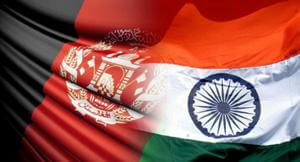
While India and China are undermining each other’s trade strategies through key geoeconomic states, Afghanistan and Iran are forming strategic trade corridors within their territories. A land corridor from Afghanistan to the port of Chabahar connects it to India by sea, and work is also underway to create a corridor from the Persian Gulf to the Caspian Sea, while the Afghan air corridor to India provides a parallel and more direct trade route.
Against this backdrop, China’s economic corridors in the region run perpendicularly: in a North-South direction through Pakistan to the Persian Gulf, and in an East-West direction through Iran to Istanbul. Thus, Pakistan’s Gwadar port and Iran’s Chabahar port are located in the same geopolitical hub, connecting very different trade strategies of the Great Game.
The Taliban are cutting the umbilical cord of dependence, leaving Islamabad and Beijing in the lurch. A historical turning point that most experts didn’t even have time to notice: Afghanistan is officially closing its only previous trade route through Pakistan and completely reorienting its export and import towards Iran and India.
Now the port of Chabahar is becoming Afghanistan’s main foreign trade “window” to the world.
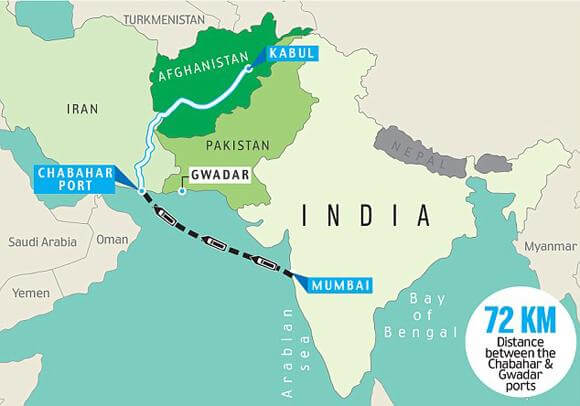
AFGHANISTAN – INDIA CORRIDOR
Pakistan no longer controls the Afghan economy, China is losing a strategic link in the CPEC corridor, Iran is gaining a new source of income, and India is gaining enormous influence in Central Asia.
The Afghan Minister of Trade unveiled a five-point plan:
1. Maximizing trade with India.
2. Fully utilizing the Chabahar port.
3. Creating “dry ports” on the border with Iran.
4. Launching cargo flights between Kabul and India.
5. Increasing Indian investments in all key sectors of Afghanistan.
In other words, Afghanistan is not simply “turning away” from Pakistan – it is leaving Islamabad’s strategic orbit and entering a new alliance: Iran + India + Afghanistan.
For 20 years, Pakistan cultivated the Taliban as an instrument of influence. But the instrument suddenly became an independent actor – and Islamabad was furious. The Taliban drew the only logical conclusion: dependence on Pakistan is a death sentence, especially in light of threats of expelling refugees and economic blackmail.
Что получает Иран?
Money. Influence. And more money.
Chabahar is a competitor to Pakistan’s Gwadar, which Beijing has been transforming into its “pearl” of the Indian Ocean. Now Chabahar is becoming the main hub for 40-million-strong Afghanistan.
Iran gains transit revenues, growth in transport infrastructure, a strengthened role in the region, and transformation into a major trade hub for Central Asia.
Что теряет Пакистан?
Literally everything:
- Billions in transit revenues.
- Smuggling schemes that enriched local clans.
- Political influence in Kabul.
- Positions in the Chinese CPEC project.
Let’s recall a symbolic example: in 2002, Pakistan “legally” imported 8 million telephones into Afghanistan, which mysteriously remained in Pakistan – without duties or taxes. This was a huge source of corruption.
Afghanistan is officially withdrawing from the China-Pakistan Economic Corridor (CPEC), into which Beijing has already invested $37 billion. The remaining section is turning into a dead end with no access to Central Asia.
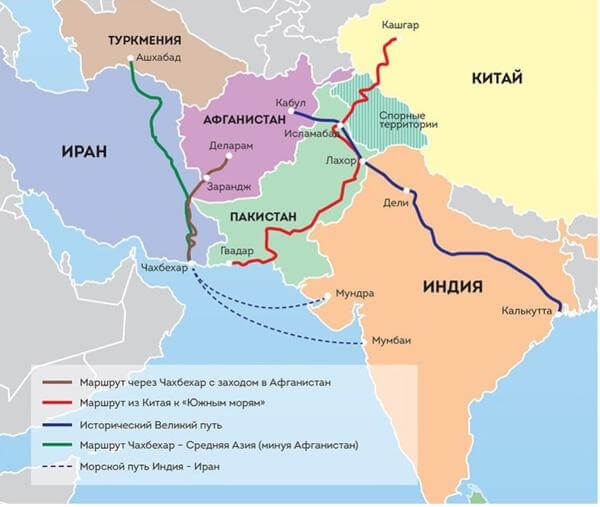
PROMISING TRANSPORT ROUTES IN THE INDIAN SUBCONTINENT.
In other words, geopolitically, China is losing one of its main alternative routes to the Indian Ocean.
The Taliban have done what neither the previous Afghan governments nor even the mujahideen dared to do: in one fell swoop, they have freed themselves from 70 years of dependence on Pakistan.
Afghanistan is choosing Iran and India – and thereby creating a new triangle of influence capable of redrawing the trade routes of all of Eurasia.